
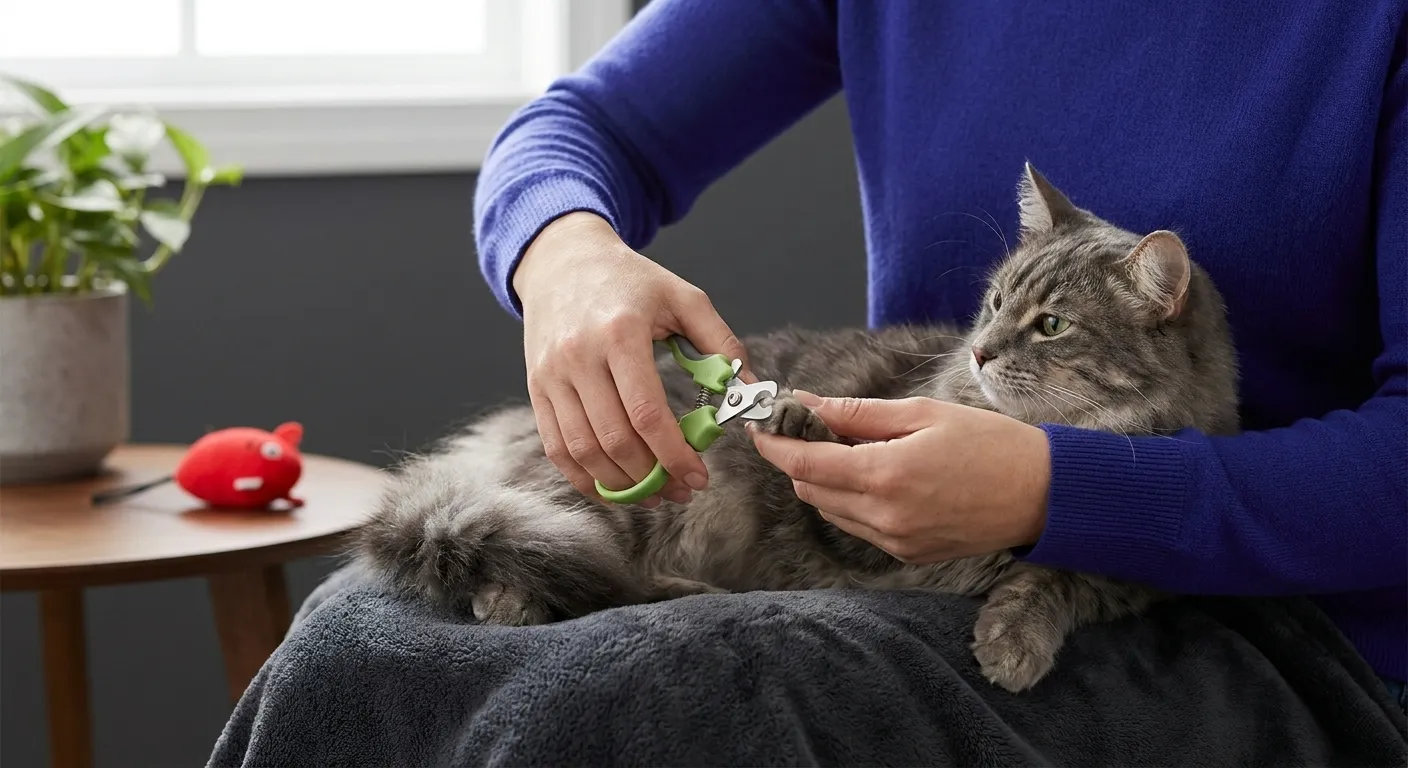
Trimming cat claws at home should begin with two questions: does this cat need a trim, and can you carry out the task comfortably after appropriate instruction? Do not assume every cat needs the same routine. Ask your veterinary team to assess claw-care needs and demonstrate the task before you attempt it, particularly if you are uncertain about handling or the claw itself.
This guide is general education, not medical or veterinary advice. It explains preparation and decision points, rather than prescribing treatment or promising a stress-free result. New claw changes, suspected growth into a paw pad, injury or discomfort need veterinary attention. A professional appointment is a suitable choice when home trimming is not appropriate or manageable.
Establish whether trimming is needed
Cats Protection’s claw-care guidance explains that trimming needs vary; an active cat may maintain its claws through scratching, while some cats need additional help. Ask your veterinary team about your cat rather than copying a fixed two-to-four-week schedule. The plan should reflect the individual cat’s claws, mobility and health.
Describe any change you have noticed without trying to correct it immediately. If you suspect a claw is growing into the pad, arrange veterinary assessment instead of attempting a home cut. The question is not how quickly you can shorten every claw. It is which care is appropriate and who can provide it comfortably.
Book a demonstration before the first attempt
Ask your vet or veterinary nurse to show suitable positioning, equipment and the boundary between the tip and the sensitive part of the claw. Explain what worries you and bring questions about visibility or handling. If the demonstration cannot be carried out comfortably, ask about the appropriate professional plan rather than assuming a stronger home hold is needed.
Repeat the instructions in your own words and take a note. Ask which claws need attention, how to stop and what to do if you make a mistake. A diagram can provide background, but it cannot assess your hands, the cat’s response or your view of an individual claw. Do not attempt a cut while those questions remain unresolved.
Choose equipment you can control
Use clippers intended for cat claws, following the veterinary team’s recommendation and the manufacturer’s instructions. Cats Protection advises against human nail clippers for this task. Compare size, handle fit and the ability to see the working area, rather than choosing solely by price or an online claim that one style suits every owner.
Inspect the tool before use. Check for damage, loose parts or a working mechanism that is different from the one demonstrated. Keep it stored securely and maintain it according to its instructions. A tool that is unfamiliar or difficult to control is a reason to pause and obtain help, not to compensate with a firmer grip on the cat.
Prepare the session without adding restraint
Choose a quiet familiar location suitable for the handling method you were shown. Arrange equipment and the instruction note before approaching the cat. Make sure visibility is clear without forcing an awkward position. Do not begin holding a paw and then search for the clippers or try to learn their mechanism while the cat waits.
This guide does not instruct you to wrap, pin, scruff or immobilize a resisting cat. If you feel restraint is necessary beyond the demonstrated comfortable method, stop and discuss alternatives with the veterinary team. A towel, carrier or grooming hammock does not provide a general guarantee of safety or calmness simply because it is marketed for grooming.
Introduce handling separately from cutting
Cats Protection’s grooming guidance recommends gradual introduction and minimal restraint. Familiarization with ordinary paw contact can be separate from a trimming session. Follow the individualized plan you were shown and do not move directly from tolerating a touch to cutting because the clippers are already nearby.
If the cat pulls away or becomes uncomfortable, stop. Do not punish the response or attempt to complete the task through distraction. Appropriate rewards can be part of a professionally advised routine, but they do not justify continuing despite resistance. Recurring difficulty should lead to guidance or professional care rather than increasingly forceful home attempts.
Understand why visibility matters
Cats Protection explains that the quick is the sensitive part of the claw and that cutting it is painful and causes bleeding. Your demonstration should make clear what you are looking at and which limited tip, if any, can be trimmed. Do not convert a general photograph into a guessed distance for every claw.
If you cannot confidently identify the relevant area, do not cut. Poor visibility, an unusual-looking claw or your own uncertainty are suitable stopping points. This article does not prescribe a universal angle or amount. Ask the veterinary team to review the specific claw rather than trying to solve uncertainty by making a fast cut.
Keep the first task small and optional
Do not require all claws to be finished in one session. Ask your adviser how to divide the task appropriately for this cat. Cats Protection’s guide supports separating work rather than making the cat tolerate everything at once. If the demonstrated task is not comfortable today, an incomplete trim is preferable to escalating handling to meet a checklist.
Record which work was actually completed so another household member does not repeat it unnecessarily. Leave unclear or changed-looking claws for assessment. The cat’s response and your control of the method matter more than a count of finished claws. A professional can help arrange ongoing care when the home routine does not meet the cat’s needs.
Know the response to a mistake in advance
Before attempting a trim, ask your veterinary team whom to contact and what to do if an injury or bleeding occurs. Keep their contact details available. This guide does not prescribe powders, household ingredients or a wound-treatment method. Do not assume that a product in a starter kit makes an injury unimportant.
Stop the trimming task if something goes wrong and obtain appropriate veterinary advice. Seek urgent care for serious bleeding, severe pain or other urgent concerns. Do not continue with the remaining claws to finish the session. When contacting the veterinary team, explain what happened and follow the individualized instructions they provide.
Treat movement changes as health concerns
If the cat is limping, moving differently or appears uncomfortable, do not make trimming the first solution. PDSA’s guidance on limping and stiffness recommends veterinary attention, with urgent assessment for sudden limping, inability to bear weight or severe pain. A visible claw issue may be relevant, but a home look cannot establish the full cause.
Describe the onset and ordinary movement you observed. Avoid repeatedly handling an uncomfortable paw or asking the cat to jump to test it. Contact your own veterinary service and follow its advice. Grooming skills are useful within their limits; they do not replace examination when a health concern changes the care decision.
Review the ongoing claw-care plan
Discuss suitable scratching opportunities and appropriate review of the claws with your veterinary team. Ask when professional help should be arranged and what changes should prompt contact sooner. Do not use a calendar reminder as permission to trim claws that do not need it or to continue a task that has become uncomfortable.
Trimming cat claws at home is an optional care arrangement that needs clear instruction, appropriate equipment and a responsive stopping rule. It cannot guarantee a stress-free experience or eliminate the need for professional help. Keep the method within what you have been shown, record what you actually did and seek assistance whenever the task or the claw’s condition is uncertain.
