
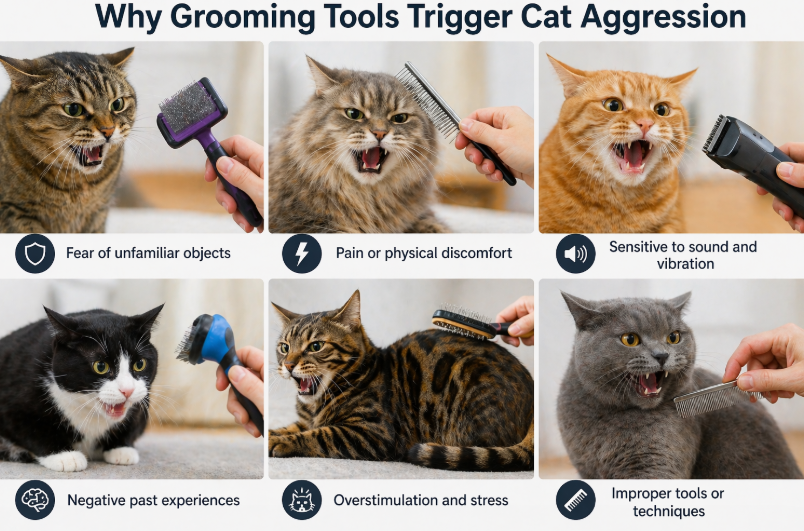
Understanding why grooming tools trigger cat aggression is essential if you want to create a safer and more comfortable grooming routine. While grooming is a necessary part of cat care, many cats react negatively when tools are introduced. This reaction can range from subtle resistance to full aggression, including hissing, scratching, or biting. Because cats are sensitive to touch, sound, and unfamiliar objects, grooming tools can easily feel threatening.
Instead of seeing aggression as bad behavior, it is more helpful to view it as communication. When grooming tools trigger cat aggression, your cat is trying to tell you something is wrong. Therefore, identifying the cause of this reaction allows you to adjust your approach. Over time, this leads to a calmer, more cooperative grooming experience that benefits both you and your cat.
Understanding A Cat’s Natural Sensitivity
To understand why grooming tools trigger cat aggression, it helps to consider how sensitive cats are by nature. Cats rely heavily on their sense of touch, and their skin contains many nerve endings. Because of this, even light pressure from a brush can feel intense.
In addition, cats prefer to control their interactions. When a tool touches them unexpectedly, they may feel vulnerable. This lack of control often triggers a defensive response. As a result, what seems like a simple grooming action can feel invasive to your cat.
Moreover, cats are highly aware of new objects. A grooming tool introduces a foreign texture, smell, and sensation. Therefore, when grooming tools trigger cat aggression, it is often due to sensory overload rather than intentional defiance.
Unfamiliar Objects And Fear Response
One of the main reasons grooming tools trigger cat aggression is fear of unfamiliar objects. Cats are naturally cautious around new items. When a brush or comb appears suddenly, your cat may interpret it as a potential threat.
This reaction is especially common if the tool has never been introduced properly. Without gradual exposure, your cat has no reason to trust it. As a result, they may respond defensively before the tool even touches them.
In addition, certain tools may look or feel strange. Large brushes, metal combs, or noisy devices can increase fear. Therefore, introducing tools slowly and allowing your cat to inspect them helps reduce anxiety and prevent aggressive reactions.
Pain And Discomfort From Grooming Tools
Another important factor in why grooming tools trigger cat aggression is physical discomfort. If a tool pulls on tangled fur or scratches the skin, it can cause pain. Once your cat associates the tool with discomfort, they are likely to resist it.
Long-haired cats are particularly at risk. Mats and tangles can make brushing painful if handled incorrectly. Even a gentle brush can hurt if used on a knot. As a result, your cat may react aggressively to avoid further pain.
In addition, using the wrong tool for your cat’s coat type can increase irritation. Not all brushes work for every cat. Therefore, choosing the right tool is essential to prevent discomfort and reduce aggression during grooming.
Sound And Vibration Sensitivity
When grooming tools trigger cat aggression, sound and vibration often play a role. Cats have highly sensitive hearing, which means even low-level noise can feel overwhelming. Tools that produce sound, such as electric clippers, can be particularly stressful.
In addition, vibration from certain grooming devices can create an unfamiliar sensation. This can make your cat feel uneasy or startled. Because cats rely on predictability, unexpected sensations can quickly lead to defensive behavior.
Even the sound of a brush moving through fur can cause discomfort for some cats. Therefore, minimizing noise and choosing quiet tools helps reduce stress. A calm environment supports a more relaxed grooming experience.
Negative Associations From Past Experiences
Past experiences strongly influence behavior when grooming tools trigger cat aggression. If your cat has had a painful or stressful grooming session before, they may associate tools with that memory.
For example, being brushed too hard or handled roughly can create lasting fear. Once this association forms, your cat may react aggressively even before grooming begins. This anticipatory response is a way to protect themselves.
In addition, repeated negative experiences reinforce this behavior. Each stressful session strengthens the association, making future grooming more difficult. Therefore, breaking this cycle requires patience and positive reinforcement.
Overstimulation During Grooming
Overstimulation is another reason grooming tools trigger cat aggression. While grooming may start calmly, prolonged contact can become overwhelming. Cats have a limit to how much stimulation they can tolerate.
As the session continues, your cat may show signs of stress. These include tail flicking, ear flattening, or sudden tension. If these signals are ignored, aggression often follows.
Because of this, shorter sessions are more effective. Stopping before your cat becomes overstimulated helps prevent negative reactions. Over time, this approach builds tolerance and reduces aggressive behavior.
Incorrect Grooming Techniques
Sometimes, grooming tools trigger cat aggression due to improper technique. Brushing too quickly or applying too much pressure can cause discomfort. Even a well-designed tool can become a problem if used incorrectly.
For example, brushing against the direction of hair growth can pull on the coat. This creates tension and irritation. Similarly, focusing too long on one area can lead to overstimulation.
In addition, skipping gentle preparation can make grooming feel abrupt. Starting with direct brushing instead of allowing your cat to relax first often increases resistance. By improving your technique, you can reduce discomfort and make grooming more acceptable.
How To Introduce Grooming Tools Properly
To reduce cases where grooming tools trigger cat aggression, proper introduction is essential. Instead of using the tool immediately, allow your cat to become familiar with it first. Let them sniff and inspect the tool without pressure.
Offering treats during this process helps create a positive association. Your cat begins to connect the presence of the tool with something enjoyable. Over time, this reduces fear and builds trust.
Once your cat is comfortable, start with very gentle contact. A few light strokes are enough at first. Gradually increasing interaction helps your cat adjust without feeling overwhelmed. This slow approach prevents aggression and encourages cooperation.
Using Positive Reinforcement To Change Behavior
Positive reinforcement is one of the most effective ways to address why grooming tools trigger cat aggression. Rewarding calm behavior helps shift your cat’s perception of grooming.
For example, giving treats after each successful interaction reinforces positive experiences. In addition, gentle praise and calm handling support a relaxed environment. Over time, your cat begins to expect rewards rather than discomfort.
Consistency is important in this process. Repeating the same positive pattern during each session builds confidence. Eventually, grooming tools become less threatening and more familiar.
Creating A Calm Grooming Routine
A structured routine helps prevent situations where grooming tools trigger cat aggression. Cats feel more secure when they know what to expect. Therefore, grooming at the same time and in the same place creates consistency.
In addition, choosing a calm moment is important. Grooming when your cat is relaxed increases cooperation. Avoid sessions during high energy or stressful situations.
A quiet environment also reduces anxiety. Limiting noise and distractions helps your cat focus and stay calm. By combining routine with a peaceful setting, you create conditions that support successful grooming.
Conclusion
Understanding why grooming tools trigger cat aggression allows you to approach grooming with patience and awareness. Instead of forcing the process, recognizing the causes helps you adjust your methods. Whether the issue is fear, discomfort, or overstimulation, each factor can be addressed with the right approach.
By introducing tools gradually, using gentle techniques, and reinforcing positive behavior, you can transform grooming into a manageable routine. Over time, your cat becomes more comfortable and less reactive. Ultimately, reducing aggression leads to a safer and more positive experience for both you and your cat.
FAQ
- Why does my cat react aggressively to grooming tools?
Cats often react due to fear, discomfort, or unfamiliar sensations from the tools. - How can I help my cat accept grooming tools?
Introduce tools slowly and use treats to build positive associations. - Are some grooming tools better than others for sensitive cats?
Yes, softer brushes and quiet tools are usually more comfortable. - Can grooming aggression be reduced over time?
Yes, with patience, consistency, and positive reinforcement, most cats improve. - Should I stop grooming if my cat becomes aggressive?
Yes, stopping early helps prevent stress and builds trust for future sessions.
