
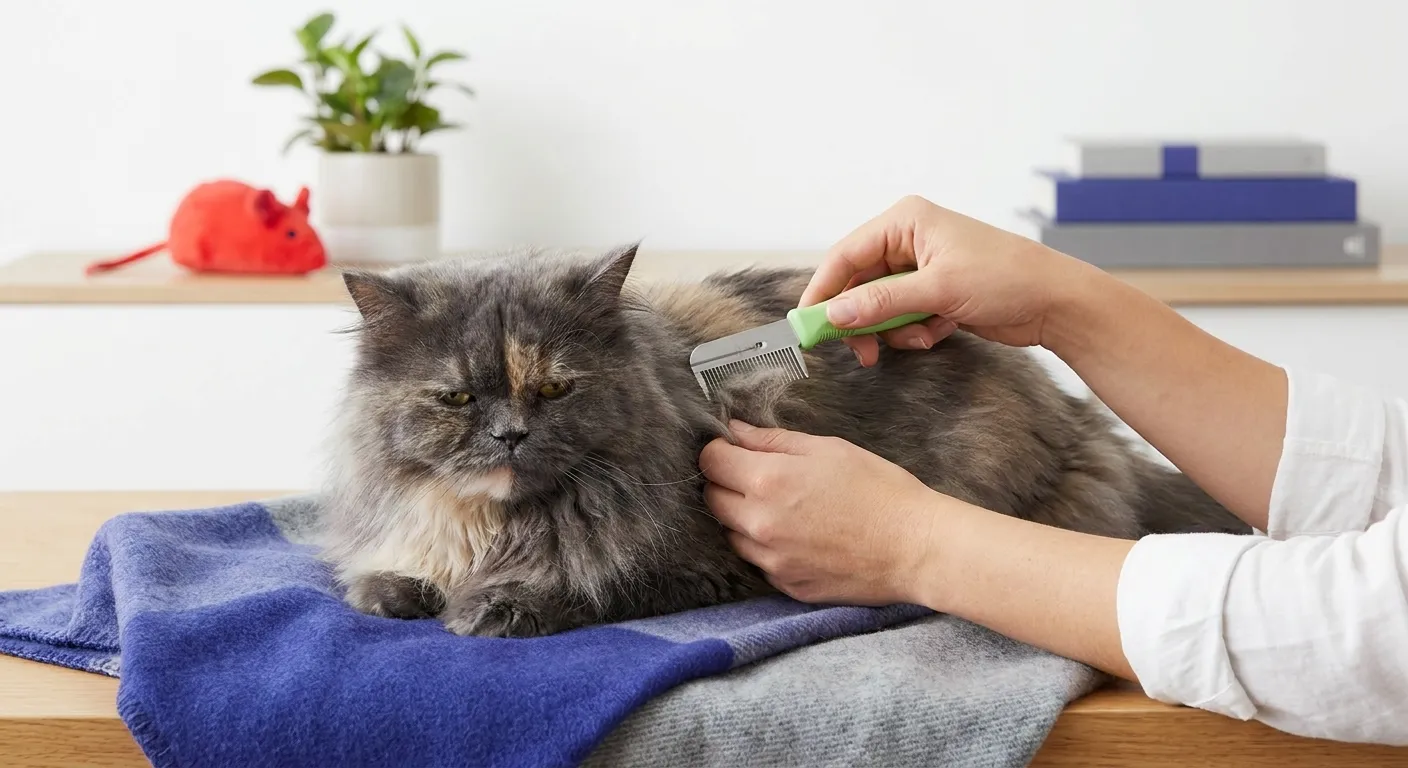
If you want to safely remove cat mats, start by deciding who should assess and handle the work. A resistant knot is not an invitation to pull harder or cut closer to the skin. The ASPCA’s guidance on matting recommends professional or veterinary help and warns against cutting mats with scissors. A practical response protects the cat’s comfort while arranging appropriate care.
This guide is general education, not medical or veterinary advice. It does not teach home clipping, prescribe treatment or promise mat removal without stress or injury. Contact your veterinary team about discomfort, skin changes or a change in your cat’s grooming. Ordinary maintenance and removal of an established mat are different tasks.
Stop the unsuccessful home attempt
If the brush or comb catches, leave that area alone rather than repeating the stroke with greater pressure. Do not try several tools in succession to find one that can force its way through. Stop if the cat is uncomfortable or resists handling. An incomplete cosmetic task is a reason to arrange help, not to increase restraint.
Put scissors, bladed dematting tools and improvised powders aside. A rounded scissor tip or a comb placed under the hair does not make a skin-close cut an appropriate beginner procedure. This article provides no cutting technique. Describe what you noticed to a competent cat groomer or your veterinary team so the next step can be assessed.
Describe the problem without probing it
Note where you noticed the resistant hair, whether more than one area seems involved and what happened during ordinary comfortable contact. Avoid pulling the mat apart or repeatedly touching the area to establish how close it is to the skin. You do not have to complete a home examination before calling for advice.
If a photograph can be taken easily without distress, ask whether it would help the professional. A photograph cannot reveal everything beneath the hair or replace an examination. Keep your description factual: location, visible appearance, when first noticed and the cat’s response. Do not label the skin infected or medically normal based on what you can see.
Choose the appropriate first contact
A cat groomer can help assess practical coat work and explain services, while a veterinarian assesses health concerns and treatment. If the cat appears painful, unwell or has a new skin concern, contact the veterinary team. Tell a proposed groomer about relevant health history and instructions already provided by your veterinarian.
Ask whether the work belongs in a grooming appointment or needs veterinary assessment first. Do not assume that every service advertised as dematting fits every cat. The condition of the coat and the cat’s handling needs determine the practical plan. If a provider recommends medical assessment, arrange it rather than requesting that cosmetic work proceed anyway.
Ask what the appointment includes
Describe the intended goal and ask how the provider decides which coat work is appropriate. Discuss handling, what happens if the cat is uncomfortable and when you will be contacted about a change. Ask whether an assessment is separate from the full service and which costs or cancellation conditions apply.
Do not request a particular haircut solely because it looks attractive in a photograph. Ask about realistic options for the actual coat. The professional should explain the work and its limits without promising zero stress or guaranteed absence of injury. Keep the agreed services in writing so an unexpected cosmetic addition is discussed rather than assumed.
Keep medication decisions with the veterinary team
This guide does not recommend sedatives, calming medication or a dose to make grooming possible. If a provider raises a medical question, discuss it directly with your veterinarian. Do not obtain a drug or improvise a product based on general grooming advice. The individual cat’s health requires appropriate assessment.
Ask how the groomer and veterinary team communicate where necessary. Share the advice you have received rather than expecting one professional to infer it from a breed name. A clear division of roles helps you understand who is responsible for the practical coat task and who handles medical decisions. Record any question that remains unresolved before the appointment.
Avoid expanding home work while awaiting advice
Do not use the waiting period to try a powder, shampoo or bladed tool that was not part of your care plan. Ask what ordinary maintenance, if any, is appropriate until the assessment. Keep unfamiliar or uncomfortable areas untouched. Follow the professional’s guidance about urgency instead of assuming the mat can wait for a convenient cosmetic date.
If the cat’s condition changes or you notice a new concern, contact the veterinary team again. Explain what has changed since the original conversation. Do not interpret temporary tolerance of touch as proof that the underlying area is healthy or that the same home attempt has become appropriate. Observation does not replace assessment.
Build a manageable maintenance plan afterward
Once the established mat has been addressed appropriately, ask for a demonstration of ongoing care. Identify the recommended tool, ordinary task, suitable frequency and stopping point for your cat. Cats Protection’s grooming guidance describes gradual introduction and minimal restraint; those principles should support the individual plan rather than a demand to finish every section.
Long-coated cats may need more owner help, but the actual coat and comfort matter. Do not copy a universal bath, clipping or brushing schedule from another cat. Ask which areas require particular attention and which need professional maintenance. If the proposed routine is not manageable at home, discuss a realistic alternative rather than agreeing to work you cannot comfortably provide.
Make a simple coat map
Draw an outline and mark the areas included in the demonstrated home routine. Note the tool and method for each permitted area, and mark any section left for professional help. This makes the plan clearer than an instruction to brush thoroughly, which can be interpreted differently by several household members.
After each ordinary session, record which areas were actually completed. Do not assume that a brush through the back means the whole coat was checked. If a new catch or resistance appears, stop that area and ask for advice. The map is a communication tool, not a home diagnostic chart or proof that the skin beneath every section is normal.
Maintain tools and household consistency
Inspect brushes and combs before use for rough contact surfaces or damaged parts. Remove loose hair and follow the manufacturer’s cleaning and drying instructions. Store equipment securely and do not assume every tool can be soaked or cleaned with the same chemical. Replace damaged parts according to the product instructions.
Share one short care note with anyone who grooms the cat. Record who completed the task and when, so the same area is not repeatedly worked by different people. Keep scissors and advanced equipment separate from the ordinary kit. If someone does not understand the demonstrated method, arrange instruction rather than expecting ownership of the tool to supply the skill.
Respond to changes rather than blaming the coat
Cats Protection recommends veterinary discussion when a cat’s grooming habits change. If the cat is grooming less, handling has become uncomfortable or matting has changed unexpectedly, contact the veterinary team. Do not diagnose a nutritional deficiency, prescribe a supplement or assume that buying a new brush resolves the reason.
To safely remove cat mats, keep established mat removal with appropriate professionals and maintain only the ordinary tasks you understand. The ASPCA’s cat grooming tips provide further general context. A clear plan can support manageable care, but it cannot guarantee that every mat is prevented. Notice resistance early, stop unsuitable work and seek help when the coat exceeds comfortable home maintenance.
